| |
The Track Day.
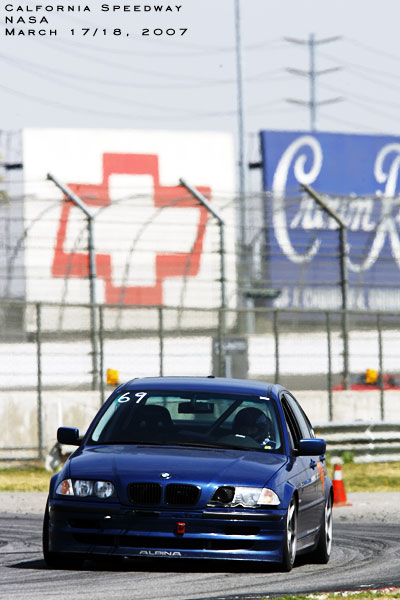
It has been almost 3.5 years since I drove at California Speedway in the same configuration, the ROVAL. The last time I drove here was back in August 2003. That was also the same time I started to pen my first track report.
The first track report is started because of my supercharger system. It was first posted as a forum posting but due to popular demand, I decided to organize the reports in a blog-like format. That first report also marks, possibly, the first BMW with a ASA compressor to be driven hard under a track setting.
Fast forward 43 months or so, I revisited the same track with the same car and being driven by the same driver. But course, a driver who has accumulated more experiences from all the track events. Not to mention, a car that is also more well prepared and fine tuned. But it is still the same supercharger system. After 44 events with the ASA supercharger, the car is still running as strong as ever.
This is the first 2007 official event for NASA time trials as well.
I came in 4th position on Saturday with a 2:03.165 and on Sunday I achieved a 2nd position with 2:01.932. John Matthews (HPDE director) did an astonishing 1:59 on Sunday. That means I have a new goal to work towards.
I would also like to thank Imad (of EMW) and his family for dropping by show support. |
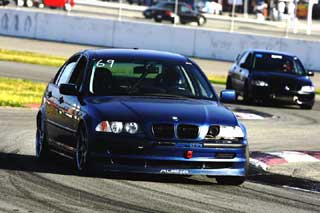
| Some pictures from the weekend. |
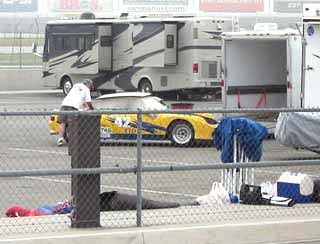
A fellow TT competitor...heh! |
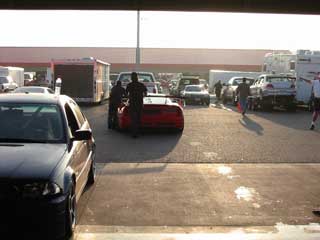
The morning begins... |
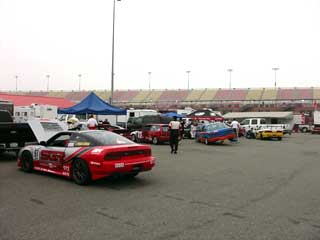
Racers preparing for the next session. |
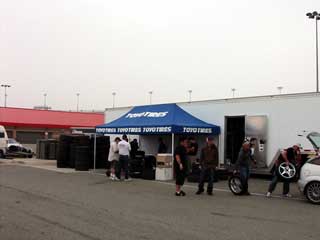
BMW AZ Selling
Toyos like hot cakes! |
Topics:
- A note on time trials (and what it is really about).
- Respecting NASCAR as a form of motorsport.
- New intake filter location
- Covering it up!
| A Note on Time Trials (and what it is really about).
Firstly, I would like to ponder on the idea of time trial.
Over and over, I have people asking "Just what on earth is time trial all about?"
I have two words that may well sum it up and that be it is a "qualifying session". If you have been following the major wheel-to-wheel racing series, F1, Grand-Am, SWC, etc, there is always qualifying session before the actual race. The purpose of a qualifying session is to determine how fast the driver is around the track under an ideal situation where he or she has the entire track to him or herself. NASA time trial is just that. But of course, we have open passing rules which actual qualifying sessions have anyway. This, in my opinion, is the simplest explanation.
"Now is this time trial thing challenging?", comes the second question. |
We can't certainly force everyone to like the idea of time trial, but truth is time trial bridges the gap between lapping for fun and wheel-to-wheel racing. It is a stepping stone for low budget track junkies like myself and frankly, I like this bridge a lot. And trust me when I say some time trialers do treat this very seriously. They do arrive in huge RVs, trailers and a pit crew as well.
Cranking up a good lap requires consistency and discipline. It requires a lot of practice, hard work, understanding of one's driving capability, car's capability and fine tuning. And to a certain extent, a bit of luck as well. The luck factor does not refer to rolling a die and hoping for the best. I am referring to track incidents, i.e. debris, spins by others, non-TT drivers who enter the track late etc, that could well spoil your hot lap. |
|
At the end of the day, the crucial thing is, what do you learn from being involved in time trials?
Being in this group gives me a chance to gauge where my driving skills stand among my competitors. It teaches me to be super humble about my skills. And really, no one brags about their laptimes. We respect each other in the group and you will lack sportsmanship if you don't play along or try to prevent others from an attempt to get a good lap. This is the same etiquette even in F1 practice session. It's a constant reality check and awakening in that if you think you're fast, someone out that can crank up a faster lap. This is when you have to go back to your drawing board and see where improvements can be made. The only thing is you have 2 sessions (2nd and 3rd) in a day to do that. The 1st session of the day is practice. The 2nd session is the REAL deal. The 3rd session is to try another best lap. Very few time trialers really try another best lap in the 4th session as the day winds down. We used to have a shootout as a 5th session but for this season, NASA has decided to abolish that.
Still, we get the occasional "Yeah sure...just do one best lap and get done with it. What's the big deal? " comment.
These are the words of someone who is too complacent and trust me, whichever class you might be in, you will be eaten alive. Time trialing is not all that easy and action speaks louder than words, so I invite you to come out and play.
NASA time trials are for people who have climbed through the ranks from NASA HPDE 1 to 4 or if you think you have what it takes. Upon approval by the time trial director, you will need to fill up a car classification form. For more information please visit the NASA TT website. Oh, one more thing. No car contacts and irrational behavior in the time trial group either. You will get booted out if you mess things up. ;-) |
| Respecting NASCAR as a Motorsport.
So who said NASCAR is boring? I did and guilty as charged.
I don't have a hatred for NASCAR but I don't really watch it on TV on a regular basis. Some time late last year, I started watching the Nextel series and only recently decided to flick to the SPEED channel just to catch a glimpse of Montoya. You've got to admit, that man does a good job in the new driving game.
What has NASCAR got to do with this report? Well this configuration includes 3/4 of an OVAL. See picture below.

The official numbers for the banking inclinations are as follow:
"The 75-foot wide track has 14-degree banking in its turns,
11-degree banking on the 3,500-foot-long frontstretch and
3-degree banking on a backstretch that stretches for 2,500 feet."
So what's the big deal with just a 14-degree banking? A protractor might not indicate much but a typical protractor has a radius of about 2.5 to 3 inches. Stretch that to 75-ft and calculate the vertical height from there and you will see what I mean. Now, imagine driving 130mph through Turn 2. Ok, now imagine driving 200mph in a racecar prepared for a NASCAR race. That's how fast NASCAR drivers flash through that turn and don't forget, it's a bumper to bumper, door to door race as well.
The turn on the OVAL pushes and pulls you. Why the push? That is because of the centrifugal force. This force of course is just the reactive force of centripetal force, which explains the pull. And there is no way of saving the car if the backend of the car starts to slip. The wall is mostly where one might end up.
Is there a trick to negotiate this turn? From what I gather
1. Hold on to the steering wheel, go full throttle all the way from Turn 19 through 1, 2 and finally slowing down before Turn 3.
2. Track out from 19 to frontstretch.
3. Car will gravitate towards the middle of the track when approaching Turn 2, then gravitate outwards again.
4. Hope that the tires stick to the ground throughout this part of the journey.
5. And please for goodness sake, don't brake in the turn. Simple physics stuff.
To be honest, I can't recall how driving on the OVAL felt like back in August 2003. On Saturday, I took the turn a little slower and my lap times were in the 2:03.XXX region. But on Sunday, I decided to push the car a lot more through the OVAL turn, and that shaved about 1 second off. |
| New Intake Filter Location The original intake filter is located on the lower driver's side behind the bumper. Almost all BMW supercharger kits use the same location for the intake filter. There is absolutely nothing wrong with that location. Just that I loathe the idea of having to use extra silicon hose, couplers and clamps to direct the air from below.
So one day, out of boredom, I decided to put a hole in the headlight cover and modify the headlight assembly. This project is still evolving as we speak. Finding the perfect filter size and modifying the perfect hole on the cover takes time.
I did however fabricate a partition plate to prevent air from creating unwanted wake and turbulence in the headlight cover. I have also allocated a couple of pressure sensors to gather what I need to find out. The partition plate creates a rather cool suction sound when the car is accelerating and changing gears. Wished I have a video camera with sound to show that...
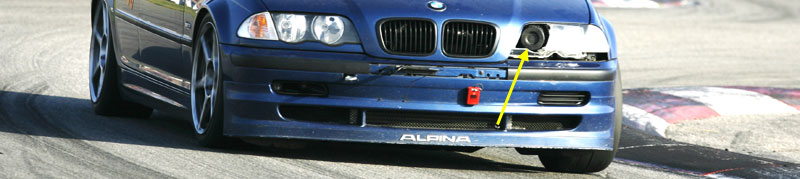
The verdict? In my opinion, this is a cleaner setup. It's not like I used the high-beam lamp anyway. :-) |
| Covering it up!
And has nothing to do with cheating or anything...so no jumping to conclusions please.
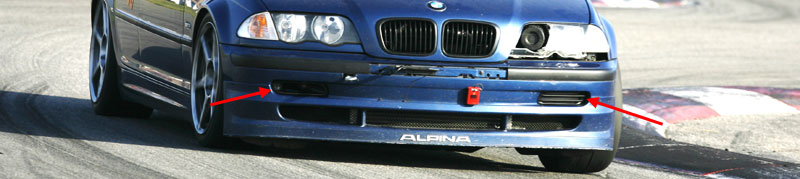
I removed my foglight assemblies (see red arrows) during the middle of the 2006 season. Lately, I have been looking into covering the bumper as much as possible. You will be surprised the effort that engineers put in just to reduce drag on a ETCC (now know as WTCC) BMW 320i. It probably won't make THAT much of a difference for a slow car like mine, but still every little aerodynamic drag counts.
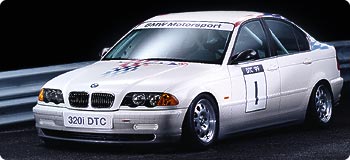
Here's what I found out. BMW actually sells foglight covers for my bumper. This is a 99~01 BMW sport sedan bumper. For 1999, BMW actually sold a batch of E46 323i without foglight assemblies. Hence they have these covers to, well, cover the bumper foglight holes. In 2000, BMW produced the E46 DTC 320i race car (as shown below). See the foglight covers? Neat!! The part numbers are 51118195294(l) and 51118195293 (r).
On the passenger's side of my bumper, I modified one of my exsiting foglight assembly. It turns out that the assembly housing is made of metal and ressembles a well designed NACA duct. This can improve flow to my secondary transmission cooler, which is just situated behind.
The verdict? I can't really quantify the advantages of covering up the openings on the track. Maybe I could do something with some complex sensor setup and data acquisition, noise filtering etc. The next step is to cover the lower driver's side of the bumper and also to improve brake duct routing as well. |

|
)